

50 Years of Pre-Insulated Pipe System Production in Vaasa
The story of district energy production in Vaasa started long before the ISOPLUS name entered the picture. Back in 1976, the local production of district heating pipes was established in Vaasa through the company Wiik & Höglund, laying the foundation for five decades of manufacturing expertise.
Company names and ownership have changed several times, but production in Vaasa has continued with the same focus: reliable deliveries, flexible customer service and technical expertise.
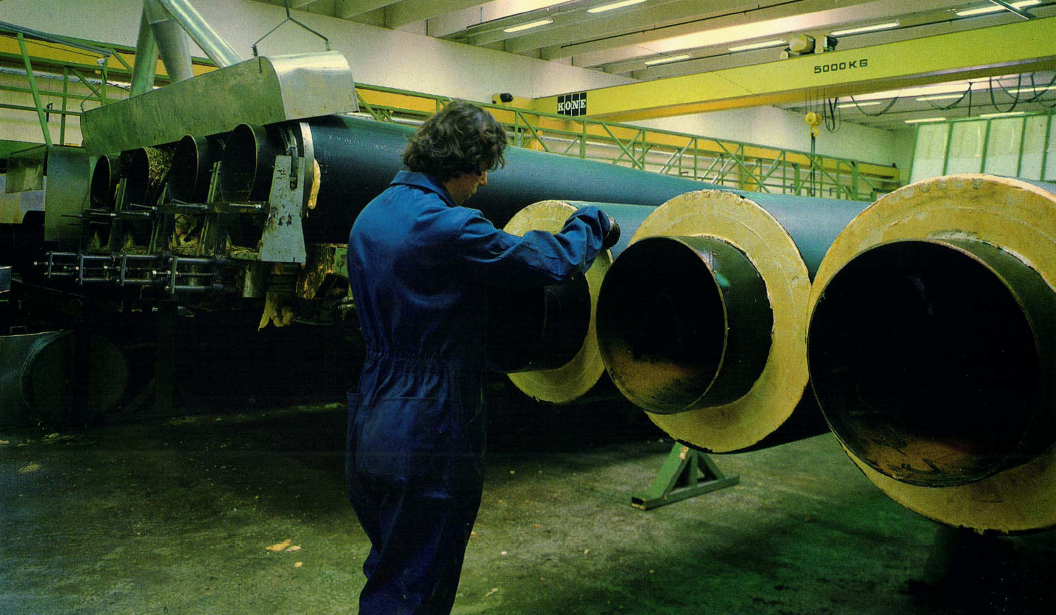
Tailored pipe systems for Nordic customers
According to Product Manager Jan-Erik Svarvén, who has worked at the factory for nearly 30 years, customers continue to value their ability to provide tailored solutions.
“We can produce highly specialised components and adapt to different customer needs. That flexibility and customer service are likely key reasons why production has remained in Vaasa for so long,” he says.
The factory supplies pipe systems mainly to energy companies in Finland and Sweden, including customers such as Fortum and Vattenfall. Located in a bilingual region of Finland, the Swedish language skills in the Vaasa factory have also become an important competitive advantage, particularly in the Nordic market.
Evolving products and growing demands
Over the decades, the products themselves have also developed significantly. While pre-insulated pipe system may look like those produced 50 years ago, the technical requirements are entirely different today.
“In the early years, DN400 was still considered a large dimension. Today, DN700 and DN800 pipes are common, and even DN1200 pipes have been produced from time to time. At the same time, the requirements for thermal conductivity have become much stricter, as energy losses must be kept to a minimum,” Svarvén explains.
One major milestone came in 1996, when PUR-insulation became completely freon-free. The transition required substantial investments and modifications to the manufacturing process, reflecting the industry’s growing environmental awareness.
The Vaasa factory has also participated in demanding infrastructure projects over the years, including underwater pipeline systems crossing waterways in Sweden, such as projects in Stockholm and Sundsvall. The factory has furthermore delivered pipe systems as far away as China, with one project involving around 200 shipping containers.
Sustainability and safety at the centre
Today, sustainability is a central part of both the products and the production process. District energy systems themselves play an important role in improving energy efficiency, but environmental responsibility is also visible inside the factory.
The company continuously works to minimise material waste and improve workplace safety. Protective equipment, ventilation improvements, lighting upgrades and risk assessments are part of everyday operations at the factory. The factory has maintained a stable workforce over the years, and many of the skilled and versatile craftsmen have supported production for decades – some throughout their entire working lives.
Electrification and waste heat recovery are reshaping the market
The entire energy sector is undergoing rapid transformation. According to Svarvén, few people could have predicted a decade ago how strongly electrification and wind power would shape the market. New customer groups, such as data centres, have emerged, while solutions involving waste heat recovery are becoming increasingly important.
“The industry has changed both for us and for our customers, and it is difficult to predict exactly what the future will look like,” he says.
Still, the foundation remains the same as it was 50 years ago: dependable deliveries, skilled local expertise and a practical mindset that keeps production running in Vaasa.

isoplus Suomi Oy:n toiminta täyttää seuraavien standardien
asettamat vaatimukset ja määräykset:



Copyright ISOPLUS Suomi Oy 2023
